Chiller systems · Selection guide
Air-Cooled vs Water-Cooled Chillers: A Project Selection Checklist
A project checklist for heat rejection, whole-plant power, water costs and service access.
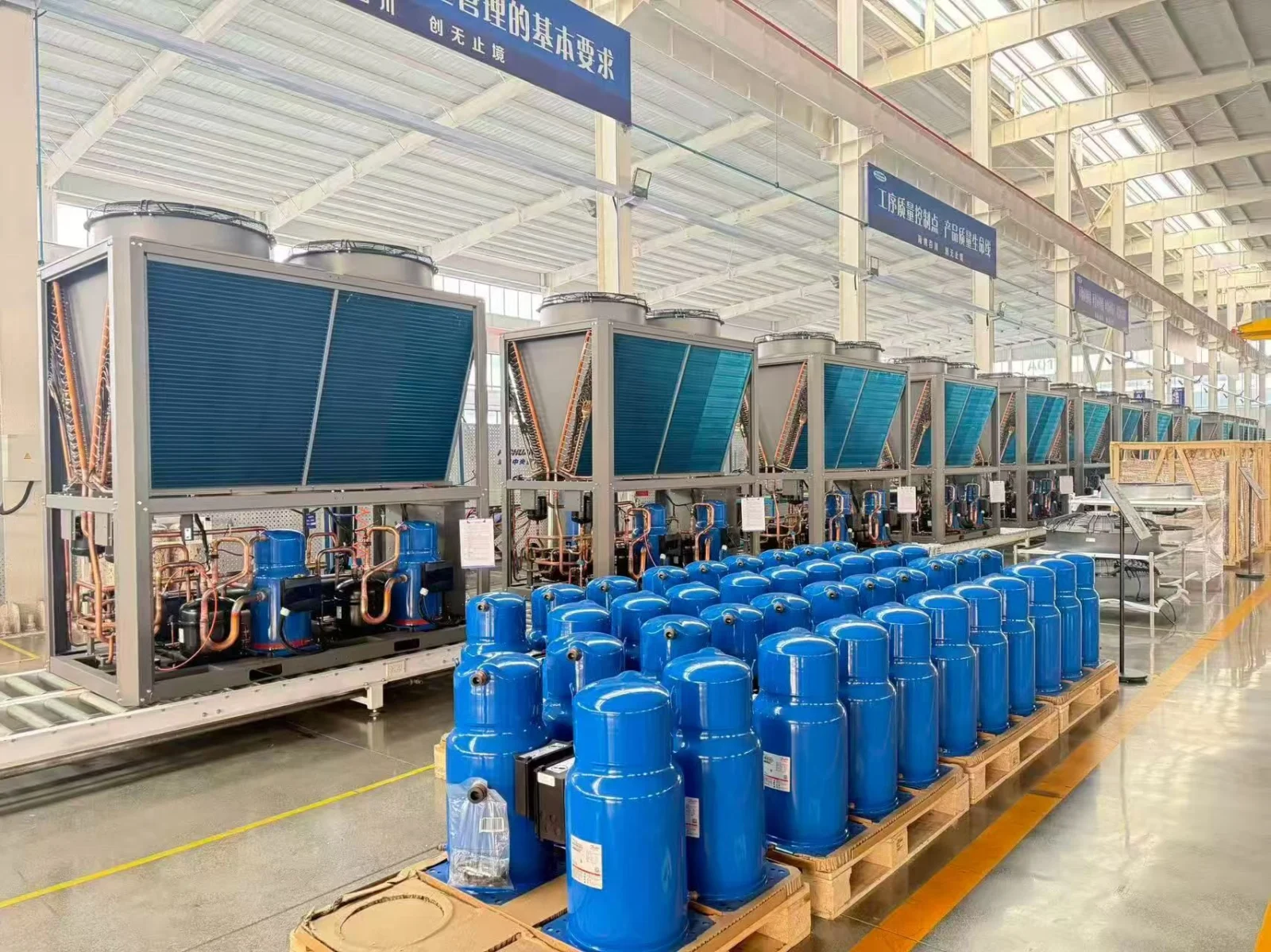
Resolve water, clearances and equipment access.
Count chiller power and required auxiliaries.
Use actual hours, tariffs and service assumptions.
Choose between air-cooled and water-cooled chillers by comparing feasible heat rejection, whole-plant energy and lifecycle scope. If the site cannot support the required condenser-water infrastructure, an attractive water-cooled chiller rating does not make that option workable. If water and operating support are available, evaluate the complete plant rather than choosing from the main chiller’s electrical input alone.
Key takeaways: both options produce chilled water; their condenser heat-rejection arrangements differ. Compare equal cooling duties and conditions, include auxiliary equipment, and use a site-specific cost model. There is no project-independent capacity threshold at which one arrangement becomes the right choice.
Prepared with AI assistance for SongXin HVAC. Draft updated September 9, 2026; human technical review has not yet been completed.
First identify where the rejected heat will go
An air-cooled chiller rejects condenser heat to air. A water-cooled chiller transfers it to a condenser-water circuit and its heat sink. This distinction concerns condenser heat rejection, not whether the building receives chilled water. Apiste’s technical explanation separates the refrigerant circuit from the circulating-water circuit.1
For a conventional commercial water-cooled plant, include the cooling tower, condenser-water pumps, water treatment and associated controls in the comparison. Different heat sinks require a different scope. An air-cooled alternative avoids that conventional tower circuit but still has a chilled-water distribution system.
The following diagram shows the comparison boundary used in this article. It represents conventional arrangements, not every available chiller configuration.
Figure: both plant options serve chilled water; the water-cooled option shown adds a separate condenser-water heat-rejection circuit.
Start product discussions with air-cooled chillers and water-cooled chillers, then ask for project selections with equivalent duty and clearly defined boundaries.
Eliminate infeasible arrangements before comparing efficiency
An option that cannot be installed or maintained is not a valid cost-saving alternative. Record site constraints before equipment selection. Treat missing infrastructure as scope to price, rather than assuming it is free or already available.
| Project condition | Evidence required from the design team | Selection consequence |
|---|---|---|
| Water availability is restricted | Available supply, permitted discharge and water-management plan | Do not assume a conventional evaporative tower is feasible |
| Outdoor equipment area is constrained | Coordinated layout, manufacturer clearances and service route | Reject a layout that cannot meet the selected equipment requirements |
| Roof or plant access is limited | Structural review, lifting route and replacement access | Include the necessary works in installed cost |
| Maintenance resources are limited | Defined responsibility for the proposed plant equipment | Compare an achievable service plan, not an assumed one |
| Site has an existing tower system | Condition, available capacity and compatibility assessment | Existing infrastructure is useful only if it supports the new design |
For air-cooled equipment, review the condenser inlet-air environment rather than only the general site weather. A location that draws in discharged hot air can differ from the nominal ambient condition used in a selection. Require the supplier to address the proposed layout and state the acceptable clearances.
For water-cooled equipment, require the entering condenser-water condition used in the selection and explain how the tower and controls will deliver it. Otherwise, the chiller rating may describe a condition the installed plant cannot maintain. These are design checks to resolve in the proposal, not reasons to assume one technology always wins.
Compare power across the same system boundary
A lower chiller input does not automatically equal a lower plant input. Add the equipment necessary to deliver the same cooling duty. Identify whether condenser fans are already included in the air-cooled rating so they are not counted twice.
The table below uses entirely fictional inputs to demonstrate the calculation. It is not a manufacturer comparison, design recommendation or measured project. All options serve an assumed 100 kW cooling duty. For this exercise, air-cooled chiller input includes condenser fans; water-cooled chiller input excludes external tower and condenser-water equipment.
| Constructed option | Chiller package input | External heat-rejection auxiliaries | Chilled-water pumping | Whole-plant input | Duty ÷ plant input |
|---|---|---|---|---|---|
| Air-cooled example | 30 kW | 0 kW | 3 kW | 33 kW | 3.03 |
| Water-cooled example A | 20 kW | 8 kW | 3 kW | 31 kW | 3.23 |
| Water-cooled example B | 20 kW | 12 kW | 3 kW | 35 kW | 2.86 |
Whole-plant input is the sum of the three electrical-input columns. The final column is a simplified cooling COP at this single assumed condition, not an annual efficiency. These assumed values demonstrate how auxiliary power can change the result; they are not typical performance ranges.
In example A, the whole-plant difference is 2 kW in favor of water cooling. In example B, it is 2 kW in favor of air cooling despite the same assumed water-cooled chiller input. The useful lesson is to establish the boundary, not to select a product from these numbers.
Do not assume identical chilled-water pumping in an actual tender. The 3 kW equality is only an illustration. Different pressure drops, flow strategies and distribution arrangements must be included in a real comparison.
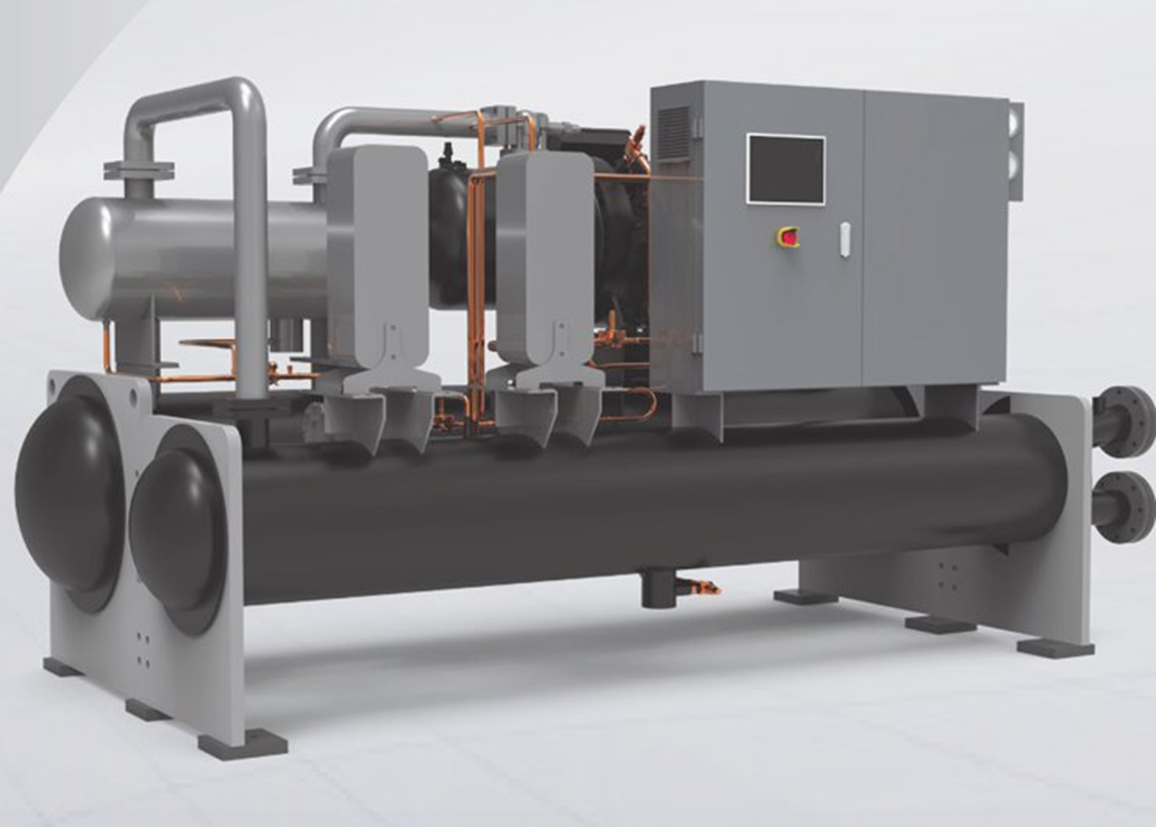
Explore water-cooled chillers
Make annual hours and water costs visible
Convert a verified power difference to annual energy with an operating model. A constant-load screening calculation is power difference × hours. A variable-load project needs the corresponding calculation across its operating periods, with auxiliary controls included.
For a sensitivity illustration, retain the assumed 2 kW advantage of water-cooled example A. Assume $0.12/kWh, $500/year in additional water and maintenance costs, and $5,000 in additional installed cost. Every input is illustrative; none is a quotation or local utility tariff.
| Assumed annual hours at the example condition | Electricity-cost saving | Net annual saving after the assumed $500 cost | Simple payback on the assumed $5,000 premium |
|---|---|---|---|
| 2,000 h | $480 | −$20 | No positive payback |
| 4,000 h | $960 | $460 | 10.87 years |
| 8,000 h | $1,920 | $1,420 | 3.52 years |
The calculation excludes demand charges, financing, discounting, escalation and equipment replacement. Its purpose is to expose the sensitivity: an apparent energy advantage can disappear when other costs are included. A full lifecycle analysis should use the owner’s evaluation period and actual service and replacement assumptions.
For context, the U.S. Department of Energy’s FEMP guidance illustrates lifecycle energy costs using specified operating hours, energy prices and discount assumptions. Its examples are not current project quotations or universal equipment lifespans. Use the same discipline of declaring assumptions, while replacing the inputs with those relevant to your project.2
Require both design-point and part-load evidence
Ask for performance at the project’s design conditions and expected operating points. A building with strongly varying demand and a process plant with sustained duty may favor different equipment selections within either cooling category.
FEMP distinguishes full-load-optimized and part-load-optimized purchasing paths and pairs the corresponding efficiency requirements. It also identifies AHRI 550/590 as the applicable performance measurement procedure for its covered chiller guidance.2 This is a reference for how ratings should be stated, not a declaration that any SongXin model is certified or that U.S. federal purchasing rules apply to every project.
In the tender comparison, keep full-load power, part-load ratings and modeled annual energy in separate columns. Request the rating conditions and method alongside each value. A weighted rating is useful for comparison within its defined basis; it does not replace the actual site’s load and weather model.
If the project involves process cooling, state the process temperature, fluid and operating profile explicitly. Do not use a comfort-cooling selection as evidence that the same equipment will meet a different process duty.
Check the maintenance and replacement route
Create a scope sheet that can be priced by both equipment and service providers. For the conventional water-cooled arrangement, include tower upkeep, condenser-water treatment and pumping equipment. For air-cooled equipment, include condenser access and cleaning requirements. Both alternatives need their own manufacturer-specific maintenance plan.
Ask each provider to identify service tasks, access requirements, consumables and equipment that must stop during service. Where the owner requires cooling continuity, show how the proposed plant maintains the agreed duty while the identified equipment is unavailable. Do not infer maintainability merely from the presence of multiple chillers.
Include the future replacement route in the drawing review. If a unit cannot be removed without major building work, that constraint belongs in the lifecycle scope now. The project design and engineering service is the relevant starting point for coordinating equipment with these site requirements.
Send an RFQ that allows an equal comparison
Provide the following design basis:
- Required cooling duty and expected operating profile.
- Chilled-water supply and return temperatures, fluid and flow requirements.
- Site weather basis and proposed equipment locations.
- Water availability, treatment responsibilities and discharge constraints.
- Available power and the proposed plant control sequence.
- Acoustic, structural, access and service-continuity requirements.
- Electricity and water tariffs, evaluation period and cost inclusions.
Request the selected model, duty and electrical input at the stated conditions. Ask for a separate schedule of pumps, tower equipment, controls and installation exclusions. Require a documented acceptance procedure with the measurement boundary and test conditions agreed before purchase.
Send this design basis through SongXin’s request-a-quote page and ask for technically comparable alternatives. The proposal should make clear what equipment is supplied and what must be provided by the project team.
Frequently asked questions
Are water-cooled chillers always cheaper to operate?
No project-independent answer is reliable. Compare the complete plant, including condenser-water pumps, tower operation, water, treatment and maintenance. Then apply the site’s load profile and tariffs. A favorable chiller efficiency rating can support a water-cooled option without proving that its complete annual operating cost is lower.
Does an air-cooled chiller mean the building has no water circuit?
No. An air-cooled chiller can still produce chilled water for the building or process. The term identifies how condenser heat is rejected. In a conventional comparison, air cooling removes the separate tower and condenser-water arrangement; it does not eliminate the chilled-water distribution circuit serving the load.
At what cooling capacity should I switch to water-cooled chillers?
There is no universal capacity crossover that applies to every site. Water availability, installation constraints, operating hours, equipment selections and service costs can change the decision. First establish feasible arrangements, then compare equal-duty proposals and lifecycle scope. Treat a capacity-only recommendation as incomplete unless the underlying project assumptions are stated.
Is IPLV enough to estimate the annual electricity bill?
No. IPLV is a weighted rating under defined conditions, not a direct prediction of a particular building’s annual consumption. Request an operating model using the site’s load and weather profile, with plant auxiliaries included. Keep the rating, design-point selection and annual-energy estimate distinct so their purposes remain clear.
References
-
Apiste, Differences between Air-cooling Type and Water-cooled Chillers, accessed September 9, 2026. Used for heat-rejection architecture and the distinction between refrigerant and circulating-water circuits. ↩
-
U.S. Department of Energy, Purchasing Energy-Efficient Electric Chillers, guidance states an October 2024 update; accessed September 9, 2026. Used for rating and lifecycle-analysis context. The fictional whole-plant and payback tables above are original arithmetic examples, not DOE or SongXin performance data. ↩↩