High-Temperature Heat Pump DHW Sizing for Hotels and Healthcare Facilities
Updated September 23, 2026.
The reliable way to size a high-temperature heat-pump domestic hot-water (DHW) system is to start with the building’s draw-off profile and required water temperatures, then select heat-pump capacity, storage and backup together. A nominal kW rating or a promise of “65°C+” is not enough: output changes with entering-water temperature, outdoor conditions, leaving-water temperature and the manufacturer’s rating point.

This guide gives a transparent method for an early design and RFQ. It is not a hygiene protocol, medical-facility commissioning procedure or a substitute for the applicable plumbing, energy and infection-control requirements.
Key takeaways
- A high-temperature heat pump is a heat-pump system designed to deliver higher leaving-water temperatures under stated conditions; “65°C+” is not a complete DHW performance schedule.
- Size the draw-off event, recovery window, storage, distribution losses and backup together. Do not size the heat pump from daily liters alone.
- Keep domestic hot water, laundry, kitchen, sterilization and other process loads separate in a healthcare brief.
- Ask for capacity, input power and efficiency at the project’s entering-water, leaving-water and ambient conditions, including the required backup sequence.
1. Define the DHW job before choosing a unit
Hotels and hospitals rarely have a flat hot-water load. A hotel may peak after breakfast; a hospital may have ward, kitchen, laundry and staff flows with different schedules. Record at least:
- rooms/beds, occupancy or patient census, staff and visitor allowance;
- fixture types, flow rates, expected draw-off temperature and mixing-valve arrangement;
- kitchen, laundry, sterilization and other process loads as separate loads—not as an assumed domestic load;
- incoming cold-water temperature by season, recirculation return temperature and distribution losses;
- storage volume, available plant-room power, ambient range, noise limits and redundancy requirement.
The SongXin high-temperature heat-pump product page describes applications in hospitality, institutional and healthcare buildings and presents 65°C+ outlet temperature as a product-level capability. It also says final selection depends on daily hot-water demand, heating load, number of users, local climate, storage and terminal/system type. Those are useful screening inputs, not a project performance guarantee.
Do not infer a hospital’s infection-control temperature, exposure time or sterilization requirement from a product page. Public-health context still matters: the NHS overview of Legionnaires’ disease notes that contaminated water droplets can be a route of infection and that hotels, hospitals and offices can be relevant settings. The facility’s water-safety plan, responsible engineer and applicable local rules must determine the actual controls.
Separate domestic hot water from healthcare process duties
REFERENCE TABLE · On small screens, scroll horizontally to read all columns.
| Load boundary | Treat it as | Project evidence still required |
|---|---|---|
| Guest rooms, wards, staff areas and ordinary fixtures | Domestic hot water | Fixture schedule, mixed-water temperature, storage and recirculation brief. |
| Laundry, kitchens and food-service equipment | A separate high-demand or process load where applicable | Appliance duty, simultaneous use, peak duration and heat-exchanger requirements. |
| Sterilization or clinical equipment | A specialized process or clinical duty, not an assumed DHW load | Equipment manufacturer requirements, facility governance and the responsible engineer’s design. |
| Hygiene control, thermal disinfection and scald protection | A water-management and safety design decision | Applicable local rules, risk assessment, mixing-valve arrangement and commissioning evidence. |
Fixture delivery temperature, tank storage temperature and recirculation return temperature are different design points. Record all three; one outlet-temperature claim cannot establish the complete water-safety strategy.
For a concrete example of why these points stay separate, the UK HSE HSG274 Part 2 guidance discusses stored-water, outlet, recirculation and scalding controls, with a different example for healthcare premises. Those are UK risk-control examples—not global requirements or SongXin product ratings. The project must use its local plumbing and public-health rules, water-safety plan and risk assessment.
The U.S. EPA Legionella guidance makes the same boundary visible from a different public-health context: building operators need a water-management program tailored to the system, and anti-scald measures still matter when higher water temperatures are used. Its household temperature examples are not commercial code values; they are a reminder to keep storage, distribution, outlet mixing and risk control as separate design questions.
2. Convert the peak event into a heat load
For a first-pass water-heating calculation:
Q (kWh) = V (L) × ρ (kg/L) × cp (kJ/kg·K) × ΔT (K) ÷ 3,600For water, an early estimate can use ρ ≈ 1 kg/L and cp ≈ 4.186 kJ/kg·K. Use the actual density and specific heat for glycol or another fluid. For a continuous recovery period, divide Q by the available recovery time in hours. Then add an explicitly identified allowance for tank, pipe and recirculation losses. Do not hide those losses inside an arbitrary “safety factor.”
Illustrative example (not a hotel or hospital design)
Assume a peak event requires 2,000 L of usable mixed water at 45°C, with 10°C cold water, and the plant has 2 hours to recover it:
Q = 2,000 × 4.186 × (45 − 10) ÷ 3,600 = 81.4 kWh
Recovery load = 81.4 ÷ 2 = 40.7 kW
If a stated 10% allowance is used only as an illustrative design assumption for tank and distribution losses, the screening load becomes about 44.8 kW. The final selection must use the actual loss calculation and the manufacturer’s capacity at the specified entering and leaving conditions. If the heat pump cannot recover the event in the available window, increase capacity, storage, recovery time or a coordinated backup source; do not simply assume that a higher outlet temperature solves the mismatch.
The reason is a timing mismatch: if draw-off energy leaves the tank faster than the heat source can replace it, the available stored volume falls even when the heat pump is running. Raising the target temperature can increase the required lift and may change capacity or input power at the same time, so the recovery schedule has to be checked rather than inferred from the outlet-temperature headline.
The example uses mixed-water demand. If the tank stores hotter water and a mixing valve supplies fixtures, calculate the usable volume using the actual stored-water temperature and cold-water temperature, then verify scald protection and local code requirements.
For an idealized first check, the relationship is:
usable mixed volume = stored volume × (Tstored − Tcold) ÷ (Tmixed − Tcold)For example, 1,400 L stored at 60°C with 10°C cold water could represent approximately 2,000 L of 45°C mixed water before tank stratification, draw-off rate, pipe losses and mixing-valve behavior are considered:
1,400 × (60 − 10) ÷ (45 − 10) = 2,000 LThis is an ideal mixing estimate, not a tank guarantee. The selected tank, sensor positions, recovery sequence and anti-scald arrangement must be checked against the actual draw-off pattern.
3. Select temperature and storage as one system
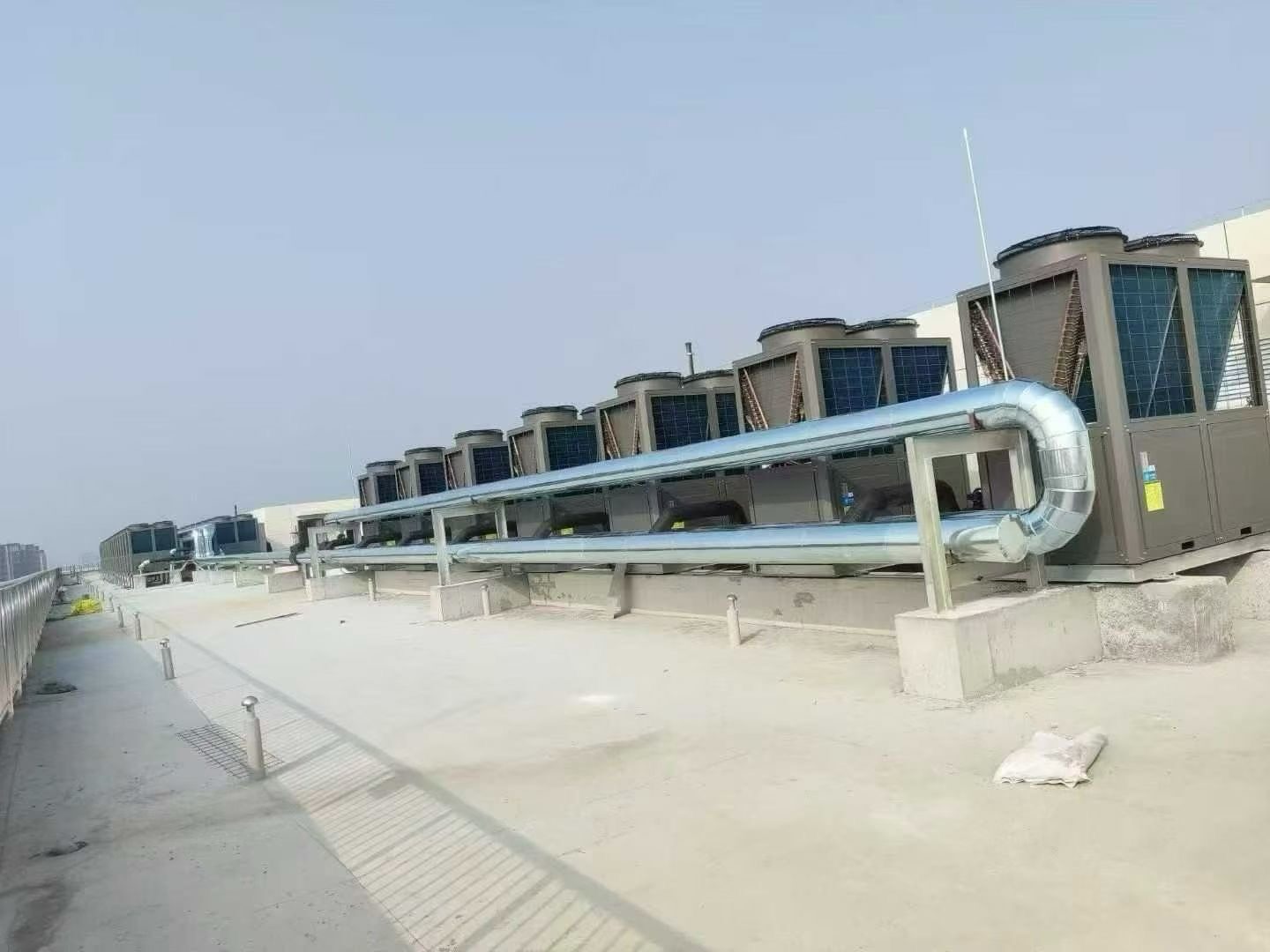
For the same heat source and equipment design, a higher sink temperature increases temperature lift and generally makes efficient heat delivery harder. Capacity and power must still come from the selected model’s performance data; not every heat pump responds identically. Request a complete performance table rather than only a maximum outlet-temperature headline. Ask for:
- rated heating capacity and input power at the project’s entering-water, leaving-water and ambient conditions;
- minimum and maximum operating ambient temperatures;
- recovery time for the proposed tank and control sequence;
- defrost behavior, minimum flow, water-side pressure drop and required water quality;
- whether the published temperature is a leaving-water limit, a storage target or a temporary cycle;
- noise, electrical supply, refrigerant, service clearances and controls/BMS points.
Usable storage can cover the shortfall between peak demand and concurrent heat-pump output. Its contribution depends on tank stratification, draw-off performance and the control sequence. Check hotel bathing and laundry peaks separately, and use the healthcare facility’s actual daily and emergency schedules. Multiple modules improve resilience only when the remaining plant, pumps, controls and power path can serve the agreed load after a failure.
Performance schedule to request from the supplier
REFERENCE TABLE · On small screens, scroll horizontally to read all columns.
| Condition | Ask the supplier to state | Why it matters |
|---|---|---|
| Design ambient | Heating capacity, input power and any defrost effect | A nominal outlet temperature does not show cold-weather recovery. |
| Cold-water entering temperature | Capacity and recovery time at the seasonal low | Lower entering temperature increases the required lift. |
| Storage leaving temperature | Capacity, power and control limit | The storage target is not necessarily the same as a short-term leaving-water limit. |
| Partial load | Minimum stable output and staging behavior | A large unit can cycle or lose useful turndown at low demand. |
| One module unavailable | Remaining capacity and backup sequence | This converts “reliable” into a testable failure case. |
An external commercial schedule illustrates the level of detail to request. The A. O. Smith AHPM performance sheet ties its water-source model’s recovery rate and maximum water temperature to stated source-water and heated-water conditions, and its table changes capacity and input power as those conditions change. It is not a SongXin rating or an air-source performance claim; it is a useful example of a traceable submittal.
The values belong in a project submittal, not in a generic product headline. The buyer should compare like-for-like rating conditions before comparing COP, price or footprint.
4. Check reliability beyond the compressor
“Reliable” means the whole DHW chain can meet its required service during realistic failure and maintenance cases. Review:
- N+1 or other required redundancy for heat-pump modules, pumps, sensors and controls where the approved architecture actually provides those standby elements;
- a backup heat source and its automatic changeover, if the risk assessment requires one;
- tank stratification, recirculation balancing, dead-leg reduction and accessible isolation;
- alarm points, trend logging, remote access and manual fallback;
- water treatment, corrosion control and maintenance access;
- commissioning tests for flow, temperatures, recovery, alarms and delivered fixture temperature.
SongXin lists heat-pump systems for heating and hot-water applications. Ask the quotation to identify who prepares the load calculation, hydraulic arrangement, commissioning plan and local compliance review; a product category does not establish those responsibilities.
Failure-response matrix
REFERENCE TABLE · On small screens, scroll horizontally to read all columns.
| Failure case | Required response to define | Evidence at commissioning |
|---|---|---|
| Heat-pump module unavailable | Remaining capacity, backup enable and operator alarm | Module-isolation functional test. |
| Circulation-pump failure | Standby pump, safe shutdown or defined degraded service | Run-proof and changeover test. |
| Cold-water temperature below design | Recovery impact and revised operating mode | Capacity schedule at the stated seasonal condition. |
| High-temperature demand exceeds normal duty | Staging, storage draw-down and backup source | Peak-event or simulated recovery test. |
5. A practical selection path
Use this sequence with the design team and supplier:
- Establish simultaneous draw-off, daily volume and peak-event volume.
- Set required fixture, storage and recirculation temperatures from the project brief and governing requirements.
- Calculate recovery energy and distribution/tank losses with stated units and assumptions.
- Test candidate capacity at the coldest design condition and highest required leaving-water temperature.
- Size storage and mixing/recirculation equipment around the peak—not around the catalogue’s largest tank.
- Check redundancy, backup, electrical demand, noise, plant-room access and controls.
- Require a project-specific submittal and review the performance conditions before purchase.
RFQ checklist
Include the following in an RFQ so competing proposals can be compared:
- location, outdoor design temperatures and cold-water temperature range;
- building type, rooms/beds, occupancy profile and fixture schedule;
- daily DHW volume, peak draw-off volume, peak time and recovery window;
- required fixture, storage, return and any process temperatures, with the responsible standard or brief;
- tank volume/material, heat-exchanger arrangement and recirculation flow;
- required capacity at named rating conditions, input power, COP and sound data;
- minimum ambient, defrost, turndown, staging and backup sequence;
- electrical supply, controls/BMS protocol, alarms and remote monitoring;
- water quality, filtration/treatment, service clearances and maintenance plan;
- redundancy target, commissioning tests, documentation, warranty and spare-parts scope.
Frequently asked questions
Can a high-temperature heat pump replace a boiler?
It may be a candidate for a defined heating or DHW duty, but replacement depends on outlet-temperature requirements, ambient conditions, recovery time, storage, electrical capacity, backup philosophy and the existing distribution system. Compare a project-specific performance schedule rather than a headline temperature.
How is DHW heat-pump recovery capacity calculated?
Calculate the energy required to raise the actual water volume through the actual temperature difference, divide by the recovery window, and then add stated tank, pipe and recirculation losses. Verify the result against the heat pump’s capacity and input power at the project’s rating conditions.
Do hospitals need backup heating?
That is a project risk decision, not a universal product rule. Separate ordinary DHW from laundry, kitchen, sterilization and clinical duties, then define the required service after a module, pump, controller or power failure with the facility’s responsible team.
What does a 65°C+ claim mean?
It identifies a product-level outlet-temperature positioning from the SongXin high-temperature heat-pump page. It does not by itself specify capacity, COP, recovery time, hygiene control or performance at the project’s entering-water and ambient conditions.
Bottom line
For a hotel or hospital DHW plant, size the event first, then verify recovery, storage, distribution and resilience at the actual temperature lift. SongXin’s published high-temperature range can identify a candidate technology, but only a project-specific performance schedule and coordinated DHW design can establish whether a selected system meets the building’s demand. Send the RFQ inputs above with the required operating conditions through the SongXin HVAC request-a-quote page; ask the supplier to return a traceable capacity, energy and control proposal rather than a single nominal model number.